We're here to help

Have a question?

Get in touch with our team. We're happy to help.

AGRICHEMICALS

Agricultural Operations

Spraying, topdressing and vertebrate toxic agents (VTAs) from an agricultural drone. Here’s what you need, and the order to do it in.

AGRICULTURAL OPERATIONS

Understanding the Requirements

Ag drone work covers aerial agrichemical application, like spraying and topdressing, as well as vertebrate toxic agents and certain other jobs involving agricultural loads.

These jobs need an appropriate Part 102 exposition and operational privileges. Applying agrichemicals from the air also needs specific training and qualifications. That’s where we come in.

Aerial application

Spraying, topdressing and vertebrate toxic agents.

Other activities

Certain operations involving agricultural, horticultural or forestry loads.

Part 102 approval

The appropriate exposition and operational privileges are required.

YOUR JOURNEY

Five Steps to Spraying

Getting qualified for agricultural drone operations involves several stages, from obtaining your Part 102 certification to completing specialist agricultural training. Start your Part 102 application first, as CAA processing can take several months. You can complete other training while you wait.

Start here

Begin your certification pathway

01

Part 102 certification

Fenix Flight Training can help prepare your Part 102 application and exposition for CAA submission, including the privileges needed for agricultural operations.

$3,600 + GST

CAA wait currently around 8 months

Learn more →

While you wait

Complete your pilot training

02

Advanced UAS course

Build the advanced remote-pilot knowledge and skills needed for more complex operations with Fenix Flight Training.

$1,545 + GST

3 days

Course dates →
03

Pilot Chemical Rating

Complete the specialist training required for agricultural chemical application through AirEx.

$4,000 + GST

2 days · Valid for 5 years

Explore Pilot Chemical Rating →

Once you’re approved

Complete your agricultural qualifications

04

Competency assessments

Complete your agricultural competency assessments. OCA can be undertaken separately or combined with ACA.

Standalone OCA $600 + GST
Combined ACA/OCA $1,200 + GST
Explore assessment options →
05

UAV Agricultural Rating

Complete the final agricultural rating training and assessment. Appropriate insurance is required.

$4,000 + GST

2–3 days · Insurance required

Explore UAV Agricultural Rating →

You’re ready to spray

Supervised, then on your own

First jobs supervised

Your first agricultural jobs are supervised. Once your examiner signs you off, you can operate independently, usually within 3–4 months.

To keep spraying

Every 12 months OCA / ACA assessment
Every 5 years Pilot Chemical Rating renewal or refresher

Additional requirements for vertebrate toxic agents (VTA)

If you plan to apply vertebrate toxic agents, you will also need a Controlled Substance Licence after completing your Pilot Chemical Rating. See the WorkSafe guidance →

HERE TO HELP

Choosing an Agricultural Drone

Agricultural drones are constantly evolving, with the major manufacturers releasing a new model at least once a year. Which agricultural drone is right for you depends on what you want to do and the features on the latest models.

The best option is to talk to the retailer/reseller. The most reputable agricultural drone brands sold in New Zealand are DJI, XAG, SPS Automation, and DO Drones.

For XAG agricultural drones talk to Airborne Solutions, and for DJI talk to AgSmart UAV, Ferntech, and Incredible Group. Click on the logos to be taken to each supplier’s website.

If you import an agricultural/spray drone from overseas then the CAA will require that it is inspected before it is flown. If you hold a Part 102 certificate then your Part 102 exposition may list the approved maintenance providers. Alternatively, contact us for a referral.

Free guide

Planning an ag drone operation?

Our guide walks you through the whole Part 102 and spraying qualification journey: the five steps, what each one involves, indicative costs, and what you’ll need to keep up afterwards.
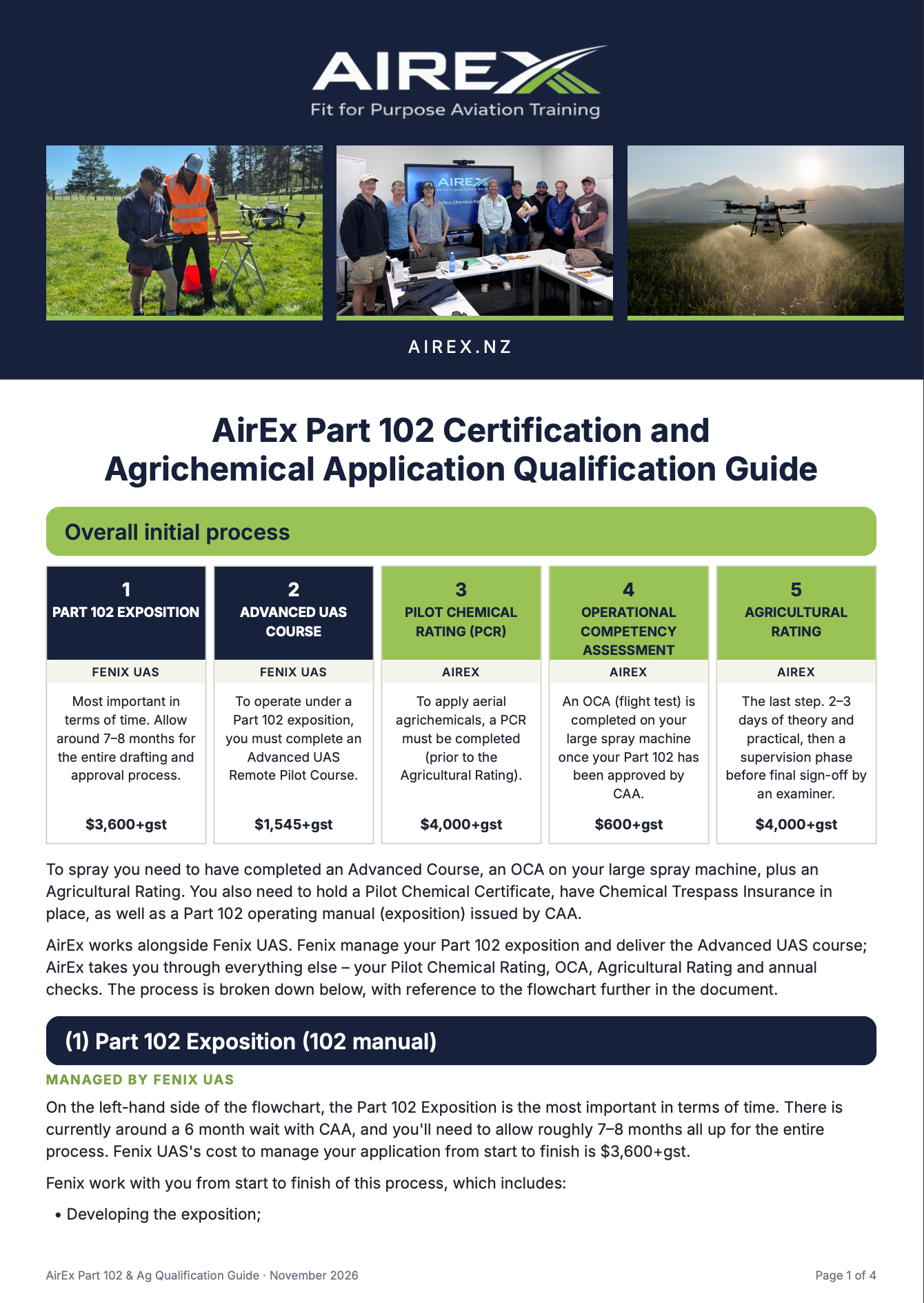
  • The five steps in order, with who delivers each
  • Indicative costs and timeframes
  • Prerequisites and insurance, sorted
Download the guide PDF · 4 pages · Updated November 2026
AirEx Part 102 Certification and Agrichemical Application Qualification Guide 5 stepsstart to finish

GET STARTED

Ready to take the next step?

Whether you’re looking to gain a new rating, complete an assessment or build on your existing skills, we’re here to help you find the right training.

FOLLOW US

© AirEx Training Limited. All rights reserved. Powered by YOOtheme.